Thursday, June 20, 2024

The Guardian

My friend Kent brought this link to my attention, an article in The Guardian by Tad DeLay.  The Guardian does a passing fair job of staying on top of climate change issues. 
 
Of course, if denialism isn't enough to make you slit your wrists, McGoey's favorite, Vaclav Smil and his doomsday writing will push you over the edge.  Pablo recommends wearing leather wrist protectors when you read things like https://e360.yale.edu/features/beyond-magical-thinking-time-to-get-real-about-climate-change.  The idea is that by the time you can unbuckle the wrist protectors, the suicidal urge will have passed.  (Let me know how that works out for you.) 
 
Something similar is happening in politics.  Many Democratic stalwarts (Caro among them) are just burned out, having dealt for so long with the MAGA party in general and The Former Guy in particular.  Doing everything we can to make sure TFG and his ilk aren't elected is critically important.  Voting is not denialism, although it would be by DeLay's definition.
 
Meanwhile, it's true that there is no individual action that can make a difference when it comes to global warming, taking individual steps do have an effect, even if not separately measurable.  And I don't call those steps "denial."  Virtue signalling can inspire others to make small lifestyle changes and they are cummulative.  My docent work at the BG lets me personally interact with and educate large numbers (well, about 600 per year) of visitors each year.  The Garden also has me plugged in to the conservation work at the BioPark, which in turn has me involved with State of NM endangered species activities.  Spurred on by Nirankar and Ty, Caro and I are diminishing our meat consumption and trying to stick to sustainable foods.  I am reminded of the parable about the hummingbird and the forest fire.
 
Capitalism is not as hopeless a case as DeLay would have you believe.  One of the biggest drivers will be the insurance industry.  Coastal flooding (I'm looking at you, Texas) intense hurricanes (hello, Louisiana), derechos, tornados, wildfires (Ruidoso this week), and all the rest will eventually make obtaining insurance prohibitively expensive or unavailable for risky rebuilds after disasters.  Hurricane and flood insurance in Florida is fast approaching that point.  When FEMA can't keep up, Congress will be forced to take action (hard to believe). 
 

Thanks for listening to my TED talk.  

The type specimen illustration of Stegnosperma for the photo tax.


Trees of the Field

Isaiah 55:12

“For you shall go out in joy and be led forth in peace; the mountains and the hills before you shall break forth into singing, and all the trees of the field shall clap their hands. 

It looks like phenologists are finally making headway on some vexing questions... https://www.quantamagazine.org/across-a-continent-trees-sync-their-fruiting-to-the-sun-20240618/.  Yet how European beech trees do it is still a mystery.  

We have a few birches in the Botanic Garden, but I don't know of any beeches, genus Fagus.  There is an American beech, Fagus grandifolia, native to our continent, but I don't know of any in our collection.    

Best I've got for a photo this evening is this one of a grand old cottonwood.


Monday, June 10, 2024

Los Poblanos

Los Poblanos Farm up the road a mile or two offered a talk and tour of their gardens hosted by fellow Nature's Notebooker, Judith Phillips.  Caro and I had a lovely time, learned a lot, and even got a few sprinkles of rain.  


I'm reminded that water is life and that millennia of human history lies beneath our every step in New Mexico.  And before that, millions of years of geology and evolution.  
 

Afterwards we had a drink and a nosh at the Campo Bar.  Met a fellow from Sandia who is in Janine's department.  Small world. 

Tuesday, June 4, 2024

The Swallowtail

After a long spring bereft of butterflies, yesterday our fennel was visited by a gravid black swallowtail.  As you can see in the video, she spent time laying more than a few eggs.  

Within a week, we'll have wee little caterpillars going about their caterpillar business.  

This is our sacrificial fennel, which the caterpillars are welcome to munch right to the ground.  Every year it rebounds with a second flush of growth (and sometimes a second crop of butterflies).  

I'll continue to buy fennel for dinner at the Co-op and leave our garden fennel to the butterflies.


Thursday, May 30, 2024

Plantaginaceae

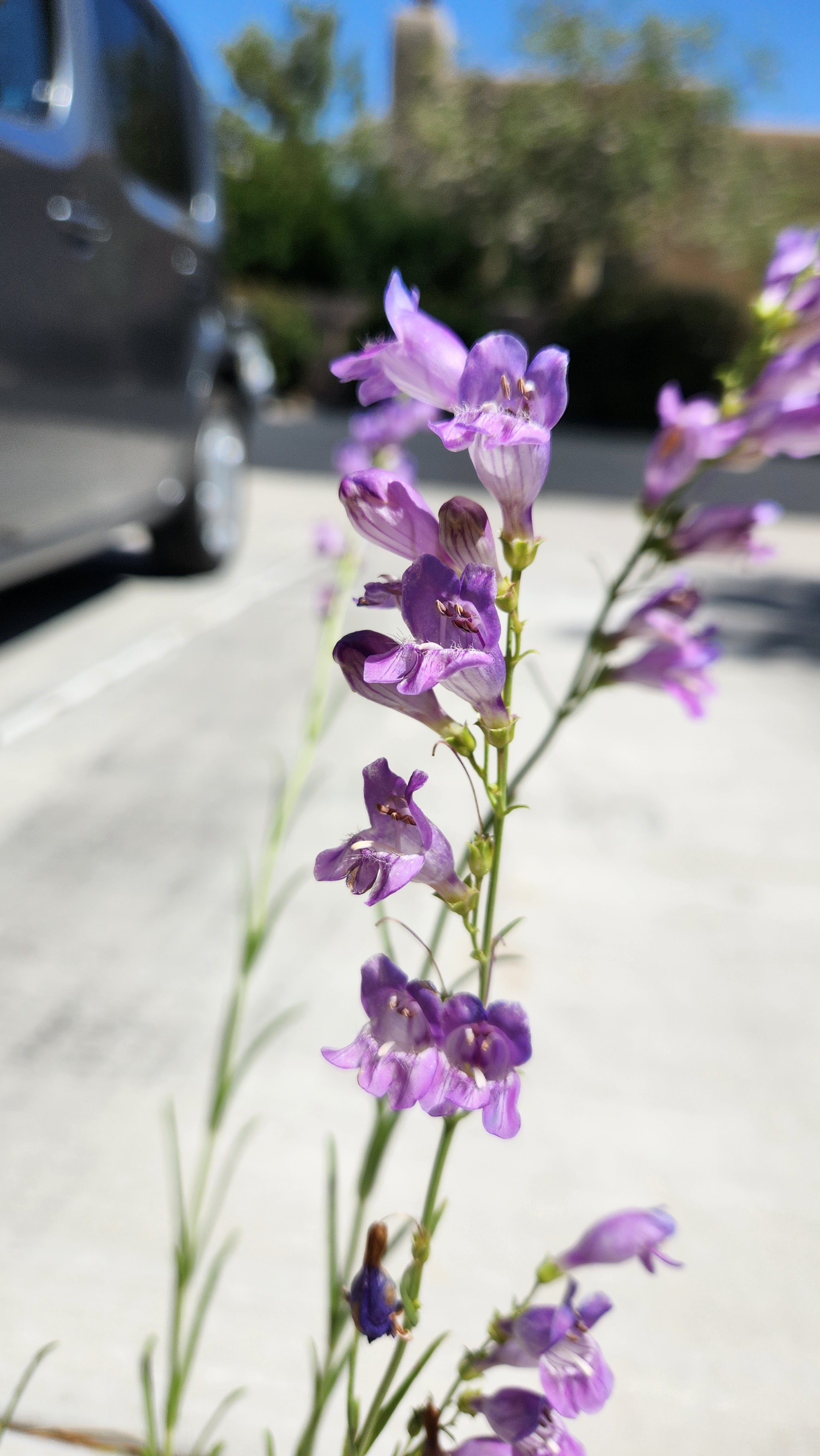
I made the acquaintance of Penstemon neomexicanus Wooton & Standl. this morning.  The BioPark held its spring plant sale to empty out the greenhouses at the Zoo.  I got there promptly at opening, but already there were many dozens of people picking over the selection.  

Fortunately, there was plenty of material.  I came away with a couple amazing Begonia cv., four pots of Verbena, and two large specimens of the beardtongue.  Caro immediately found spots for them all in our garden or in the sunroom.  

P. neomexicanus grows on Poppy Hill in the Botanic Garden's Heritage Farm.  My specimens come from wild-collected material that our IUCN specialists found near Ruidoso.  There's some question about the precise identification.  It may just be that the species is hybridizing with introduced Penstemon strictus or there's more variability than we're aware of in these populations.  

Either way, the plants are lovely and perennial.  I plan on enjoying them for years.  


Sunday, May 19, 2024

The Duranes Acequia

Caro and I took a stroll from Veranda south along the Duranes lateral to Dulcinia Park.  It's getting warm and there wasn't as much shade as other ditches we've walked.  Some spring flowers are nearly finished and the summer plants are starting to come in.  Here's my species list:

  • Siberian elm
  • Baccharis
  • Wisteria
  • Rio Grande cottonwood
  • Ornamental plum
  • Four-wing salt bush
  • Kochia
  • Seep willow
  • Sow thistle
  • False indigo bush
  • Foxtails
  • Horse nettle
  • Rocket
  • and a couple mystery grasses  
On the drive out of the parking area, we saw a couple gorgeous cacti in bloom.

Echinocereus

Opuntia


Sunday, May 5, 2024

Fallugia paradoxa

Having a lazy Sunday morning and a recent FB post about Apache plume tickled my curiosity.   I'd never really given much thought to its authority, the part of a scientific name that follows the binomial and identifies the author(s).  Wikipedia gives "Fallugia paradoxa (D.Don) Endl." but there's more to the story than just David Don and Stephan Endlicher naming this striking plant back in the early 1800's.  Looking at Kew's Plants of the World entry reveals that the full authority is (D.Don ex Tilloch & Taylor) Endl. ex Torr.  That's a mouthful and needs some serious decoding.  

It was time to get another dose of caffeine and take a deep dive into taxonomic nomenclature and botanical history.  

It appears that specimens of Apache plume made it back to taxonomists in Europe in the early 1800's.  As best I can tell from James Henrickson's 2001 article, the first Apache plume specimens collected by Europeans were from the M. Sessé and J.M. Mociño expeditions* (1788-1803).  Their materials were processed by José Antonio Pavón Jiménez and labeled under his name.  The location from the label can be viewed on Google Maps. 
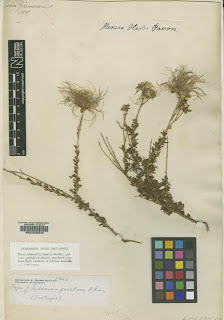
Digital image of the type specimen in the British Natural History Museum

Somehow** one of them found its way to London and the Scottish botanist David Don, the librarian of the Linnaean Society and curator of the Lambert Herbarium, must've come across it.  Don was the son of a curator of the Royal Botanic Garden in Edinburgh and had a keen eye towards New World plants.  The list of taxa that he named is lengthy, even by 19th century standards.  (As an aside, he spotted a specimen of the California coast redwood and named it Taxodium sempervirens.  Later this taxon was placed in a separate genus that we now know as Sequoia sempervirens.)  

But I digress.  

Don named the Apache plume Sieversia paradoxa, placing it in a genus of the rose family found in northwestern Asia.  Richard Taylor and Alexander Tilloch, the two editors of an early natural history publication, the Philosophical Magazine, picked up Don's work and officially published it in their journal in 1824.  In the obscure world of botanical nomenclature, this is shown as Sieversia paradoxa D.Don ex Tilloch & Taylor.  

Here's ex decoded:  "The  word ex is mainly used in circumstances in which there is an author (or authors) who only contributes the name of a taxon, while it is a different author (or authors) who actually validly publishes that name.  In  these cases, the author(s) who ascribed the name is separated from the publishing author(s) by ex."  

OK so far.  Taylor and Tilloch took Don's work and get partial credit, thus assuring their 19th century version of botanical immortality.  

Apparently there were a number of illustrated specimens floating around Europe at this time from the Sessé and Mociño expeditions.  The famous botanist de Candolle obtained their drawings, saw Apache plume, and placed it in the Rosaceous genus, Geum (common name avens), with the specific epithet of cercocarpoides (probably due to the fruits' similarity to those of Cercocarpus).  Nicolas Charles Seringe, a French medical doctor and botanist teaching in Lyon, published this in de Candolles' Prodromus in 1825 as Geum cercocarpoides DC. ex Ser.  

Sorry, Nick, you're too late.  Your new Geum name is a synonym for a previously validly published name.  

In another twist, I see that the well-traveled German botanist, Ernst Gottlieb von Steudel, must've seen the same specimen that Don worked off of.  In 1840 von Steudel placed it in Geum also, giving us Geum paradoxum.  The change from paradoxa to paradoxum was due to the Latin gender of the generic names.   

Nice try, Ernst, but our Apache plume isn't an avens.  

So where does Fallugia come from and what's with the parentheses and Endl. ex Torr.?  

In 1840 a fellow named Stephan Endlicher noticed the disjunct between our southwestern Apache plume and the rest of Sieversia.  He created the genus Fallugia to segregate the taxa.  Wilhelm Gerhard Walpers in Germany saw one of the New World specimens (not Don's original) and published the name Fallugia mexicana Wald. in 1840.  Had he known that Don had already had created a valid specific epithet, he could've saved us some time.   

Meanwhile, back in the U.S., John Torrey was busy working with the likes of Asa Gray to process the torrent of material coming back from expeditions in the western territories.  Specimens collected on expeditions led by Major Stephen H. Long (1820) and John C. Frémont (1845) were revealing the botanical riches of the American west.    

In any event, Torrey recognized that Don's Sieversia paradoxa needed to be placed in Fallugia.  That gives us Fallugia Endl. ex Torr.  However, when taxa get shuffled around into new combinations, the original source of the name is attributed to the first author(s) by placing their names within parentheses to give credit where credit is due.  So Don's paradoxa was combined with Endlicher's Fallugia by Torrey, giving us the wonderfully complex Fallugia paradoxa (D.Don ex Tilloch & Taylor) Endl. ex Torr.  

Whew!  What a roll through botanical history, all wrapped up in a scientific name.  

_______________

*  Funny how Wikipedia doesn't have any references on these explorers.  #justsaying

** There seems to be a connection between Pavón and Aylmer Lambert, the prodigious botanical collector of the day.  Lambert was known to track down specimens to add to his collection of 50,000 plants.